Sales presentations are the cornerstone of many companies’ sales efforts, yet so often they aren’t given the time and attention they deserve. Thrown together at the last-minute, often your sales reps stand up in front of a sales presentation that’s nothing more than a glorified page of notes.
The right sales presentation can be the Excalibur to your rep’s King Arthur. But if you’re sending your troops into battle with a wooden sword, they won’t be terribly successful – or do much dragon-slaying for that matter.
How to use this article
In this article you’ll find everything you need to know about sales presentations – what they are, how to go about writing a killer one, and how to deliver it like a pro. We’d recommend starting at the beginning – we’ve heard it’s a very good place to start – but you can also use the links below to jump to your favourite bit.
Outside of the telephone and email (and CRM), what’s the most important sales tool in most B2B companies? After careful consideration, I think it’s PowerPoint: salespeople use presentations all the time when talking to prospects.
What is a sales presentation: A sales presentation is a talk which promotes a product or service that you are trying to sell, which includes illustrative material such as slides, sketches, or props.
But!
Can most reps use PowerPoint properly?
Can most marketing departments use it well?
Are most reps given adequate slide decks to sell with?
Do most reps have the content to enable great visual sales conversations?
Are reps still wasting good leads by inflicting ‘Death by PowerPoint’?
The problem: How many opportunities do you create each month? Think about how valuable those opportunities are – not just in terms of whether you have enough of them, but also your cost per opportunity – all that marketing spend that gets you face-to-face with a prospect. And then how much did you spend on your sales presentation – the sales tool that helps tell your sales story and communicate value to prospects? For a lot of companies, it’s nothing.
People must think that creating sales tools is easy. Just open PowerPoint and type some bullet points to get your message across. Maybe if you’re feeling fancy, ask a graphic designer to take a look.
Never mind that arming your sales teams to read bullet points (even pretty bullet points) won’t work.
Never mind that the same techniques that work for a charismatic speaker talking to 1000 people at a conference don’t work when your average sales rep is delivering their sales presentation to four people from a laptop.
Why change: The figures on how buyers feel about sales people and sales meetings suggest a communication failure: just 22% feel that sales people understand their issues and how they can offer value (Forrester). Looking at the sales presentations that many companies use confirms the same view: this isn’t an area that marketing has mastered.
Improving conversion rates at the bottom of the funnel is equivalent to sourcing many more ‘sales-accepted leads’ or finding 1000s more prospects. For this reason, improving your sales presentations is one of the most impactful things that a marketing team can do.
If your sales tools aren’t persuasive and compelling, if your sales people are spending time creating their own clandestine collateral, or if your conversion rates are too low – you need to do something different.
A PowerPoint sales pitch allows you both to capture the messages you want to present to prospects (straight from the minds of your best sales people) and to distribute these messages in a way that others can use too. So how do we make sure we write a good presentation?
Always prepare properly: I’m going to begin with a disclaimer – creating an effective sales presentation takes hours. Before you even open PowerPoint, there’s a whole pile of stuff that it’s better to know beforehand: content, length, who will be presenting, how complex will your slides be, will you use icons or pictures, colour scheme, deadlines…and the list goes on.
You see, you can’t just make a sales tool and then throw it over the fence to the sales team. You need to work with them to find out what they need. When do they talk to prospects? What messages are they trying to articulate? What objections are they seeing? Where are competitors gaining ground? In summary, what conversations are sales people having that visual slides could support?
Gathering this kind of information does (and should) take time – and it’s definitely worth investing in it to do it properly.
The voice of the customer is often missing in sales messaging. The solution? Just ask customers why they buy from you, or what you do that they value. Better yet, ask them what challenges they face (in your field of influence); now you can start to identify opportunities – areas where they need help but where you don’t currently have competitive advantage.
One word of caution though. Stated preferences and revealed preferences aren’t the same. Just because customers say they want something, doesn’t mean that they do. Offer them a real choice of products, and see what they choose – that’s a revealed preference.
To acquire new – different – customers, it makes sense to talk to those who aren’t currently buying from you, not just those who are. They may have different thoughts, value different things, and have a different view of your competitive strengths.
Here are some good questions to find the answers to:
What are your prospects doing now?
What do you want them to do?
What are they thinking now?
What do you want them to think?
How are they feeling now?
How do you want them to feel?
With all this data gathering done, you can move on – no, not to PowerPoint – to understanding what kind of a change you want your prospects to make, and then with that knowledge, you can set clear (and SMART) sales presentation objectives.
Sales presentation objectives: Setting the wrong goals – unrealistic goals – for your sales presentation won’t help you. Before you work out what to say, you need to be clear about what you are trying to achieve with a sales presentation or sales conversation.
There are plenty of possible objectives, beyond making the sale immediately:
To be invited to respond to a tender
To be down-selected to the next round of a bidding process
To be allowed to help write the tender
To be invited back to meet with the decision maker
For the prospect to meet with your technical consultant
To get permission to run a study
For your prospect to start a trial
For your prospect to commit to a technical evaluation.
There are dozens of things you might want or need en-route to a sale. Be very clear about what you are trying to achieve before you write your sales presentation.
Writing a sales presentation: Context and competition
Understanding who you are competing with – in terms of how prospects are currently approaching the issues that you address – is fundamental to your sales messaging. If your sales messaging is directed against other companies, but your prospects aren’t even aware that they have a problem, or are thinking in terms of whether to keep on doing things in-house, you are selling the wrong thing.
There is one crucial question you need to ask:
Who are you competing with?
Are you competing with the status quo or apathy?
Are you competing with a DIY approach to solving the problem?
Are you competing with solving the problem in a different way?
Are you competing with companies you recognise as competitors?
Are you competing with companies that you don’t even recognise as competitors?
‘Why change’ vs. ‘Why us’
Sales messages when selling a category (‘Why change?’, whether to buy) should be different from those used when selling a particular solution (‘Why us?’, which one to buy).
Have they decided to change, or do you need to persuade them?
Do they know what category of solution they are looking for, or is that still open?
Have they got established decision-making criteria, or can you shape their thinking?
Will they talk to other companies, or could you win this before anyone else is involved?
Why change: At the start of the sales cycle, prospects might not be aware that they have a problem. They might not recognise that a problem they have can be solved. They could have no knowledge of the market you are in, or the vendors who might want to help them. At this stage, messaging needs to focus on bringing out the problems that they have, and all the messy implications. Fear of change, and a certain inertia are the main obstacle to overcome. You need to make it very clear that the prospect has a problem – if they realise it or not – and that the problem is hurting them – perhaps in subtle ways – but it is hurting.
Why us: Once a prospect acknowledges they have a problem, they start to try and find somebody who can help them to solve it. At this point, messaging needs to answer the question ‘Why us?’.
Writing a sales presentation: Persuasive structure
There’s no single way to structure a sales meeting or a sales presentation – as you move through the sales cycle, different things are required. At the very first meeting, you are likely to be fact-finding, exploring whether your company’s solutions are a good fit for the prospect, and discovering what challenges they feel most urgently. At a best-and-final pitch presentation, you may be responding to an entirely prescriptive meeting agenda, with scoring on how well you answer certain questions.
Here are a few good starting points to make sure, at whatever point you are in the sales cycle, your content is always structured in a compelling way.
How not to structure: Did you ever notice how a journey seems to take longer when you don’t know how far you have to go? Sales presentations are the same.
Those sales presentations that do make the structure visible – by using agendas – usually make the mistake of using headings that mean more to the presenter than the audience, or that are so dry that they do absolutely nothing to help sell.
Focus on the benefits: One way to make an audience-centred agenda is to think in terms of benefits: what’s in it for your audience. Don’t make the mistake of only talking about benefits in a summary slide right at the end of your presentation. The benefit slide can be used as an agenda that appears as a segue between sections.
The advantages or benefits are stated early enough to be noticed
The agenda is now audience-focused, not product-focused
By showing a slide with the benefits multiple times during your presentation, you help your audience to remember your key points
Now that’s a powerful and persuasive presentation structure!
How to write your value proposition: Though it may seem like a dark art, writing a value proposition is something anyone can do. There’s quite a simple formula that you can use:
Decide whether you are answering ‘Why change?’ or ‘Why us?’
List the three to five best answers to the question
Create a slide that shows these answers
Use that slide as an agenda to help structure your sales presentation, and show it each time you segue from one section to the next
Arrange your content into sections according to the benefits or advantages they support. Typically, you might want a few slides in each section.
Use the agenda slide to close the presentation
How many points should a value proposition have: Value propositions should be comprised of 3-5 statements about what your solution or type of solution offers. Any more becomes harder to remember. Any less can fail to structure the presentation content effectively and memorably.
In this fascinating article reporting on research by Weaver et al in the Journal of Consumer Research, Heidi Halvorson points out that adding additional arguments doesn’t always help. If a value proposition has three very strong sections, adding an additional section that’s weaker (but still valid) actually dilutes the overall strength of the argument.
How to write a value proposition statement: Value proposition statements work best if they are of similar length and format. If one item is a single word (‘flexible’) and another is a long phrase (‘standards compliant for SIA accreditation’), it often looks and sounds awkward.
The best way to get the phrasing right is to note a question that the value proposition answers, and format all items to work with that question. So, for example:
Why change? ‘You should change in this way because you will get ___’
Why us? ‘Choose us because we offer ___’
Category vs. solution: When selling the category, the key messages of your sales presentation will typically be made up of benefits, and focus on what your prospects will get if they try a new approach – ‘increase turnover’, ‘reduce risk’, or ‘improve efficiency’.
When selling your solution, the key messages (or value proposition) will typically be made up of advantages that your product or service has over competing alternatives. If you used benefits here, there’s a risk that competing solutions would all just say the same thing, and you wouldn’t be able to differentiate.
Ordering your value proposition: Once you know your value proposition, you need to decide on the right order for your sections. Many presenters fail to look at structure from the audience’s point of view, and, as such, they make incorrect assumptions about what should go where. Stop and imagine you’re seeing this content for the very first time. What do you need to know first? What is the logical order to approach and take in these points? Opt for logic and simplicity and you won’t go far wrong.
Interactive presentations – let your audience choose: One way to structure a sales presentation is to do something interactive – non-linear. That means you can have a conversation without any pre-determined flow, and show things in response to the way in which the sales conversation develops.
Break your content up into smaller chunks – a few minutes of material at a time. Switch between topics of conversation based on what your audience says to you. So, instead of a single presentation with 30 slides, think more in terms of six topics with five slides in each. You might use some of them, or all of them. You might present them in a different order each time. The point is that you have a conversation and respond to what you are hearing.
Writing a sales presentation: Sales presentation introductions
A lot of presentations we see are very front-heavy: the presenter talks for slides and slides about the company, about their amazing product, and about why you would obviously want to be a part of what they’ve got going on. The trouble is – I’m sorry – no-one cares.
The problem: Often sales presentations are written from the point of view of Product Marketing, and not the audience. If the first few slides are about ‘My Company’, ‘Company Structure’, ‘Company History’, ‘Office Locations’, and ‘Revenue by Division’ – chances are the audience is getting bored before the presenter even gets started.
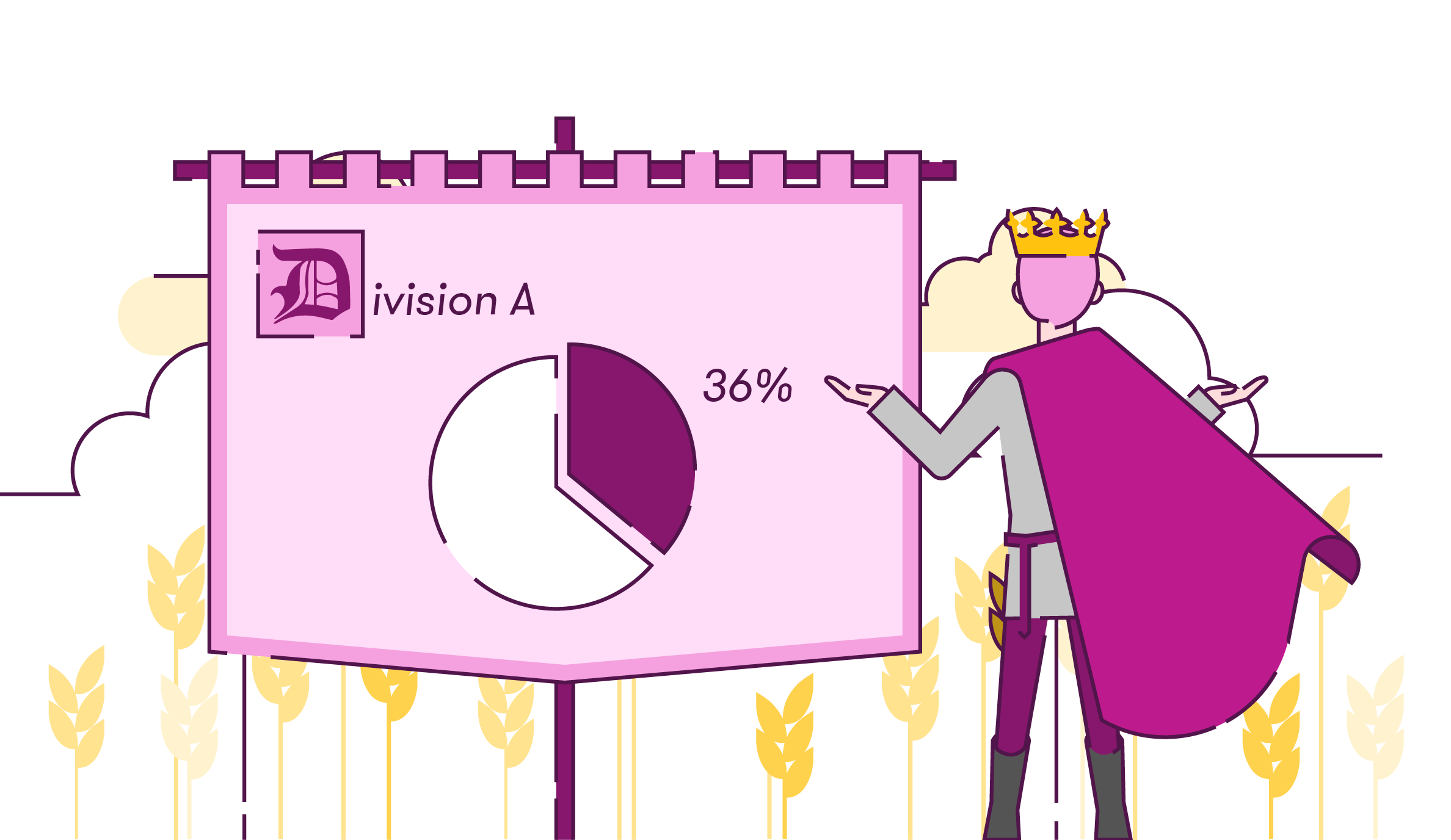
Lose the slides about your company history and awards and clients and internal structure. Nobody ever bought anything because Division A accounts for 36% of turnover.
They already know about your company, from your website. You don’t need to build credibility – they accepted the appointment. And it wastes precious time… Why spend the first five minutes of your sales presentation talking about you, when they want to know what you can do for them. It will just risk boring them, and ensure that attention levels plummet before you get going.
The solution: The start of a sales presentation should be interesting. That means encouraging reps to stop playing 20 questions, stop talking about the size of their company, and start challenging prospects to see the world in new ways. Explain why something is an important issue, and why current attempts to solve the problem don’t and won’t work.
Your sales presentation introduction ought to build credibility – but the way to do that is by showing that you understand the prospect’s challenges, that the standard ways of meeting these challenges don’t work, and that the prospect may need to do things differently.
Credibility is gained by having something interesting to say, not just by going on about your company in an entirely predictable way.
Do not rest on the assumption that just because you are standing in front of a screen dressed nicely that people will want to give you their attention. Many people you present to will not be inclined to care about what you are saying until you give them a really good reason to. In order to get your audience engaged, you have to bring them into the presentation by identifying their needs or addressing a problem they may be having.
Questions to consider:
What challenges do companies like your prospect’s tend to face?
Why have they been unsuccessful in overcoming these challenges so far?
What do these problems cost them?
What would a solution to these challenges look like?
In The Challenger Sale, Dixon & Adamson reveal research into what customers want from sales reps. Ranking right at the top (below only ‘professionalism’) of things influential buyers want from sellers is a rep who:
‘Offers unique, valuable insights’, and
‘Frequently educates me on issues and outcomes.’
Don’t just tell customers what they want to hear. Educate them, and tell them what you think they need to hear. Challenger reps ought to deliver a teaching pitch: ‘A teaching pitch makes customers feel sort of sick about all the money they’re wasting, or revenue they’re missing, or risk they’re unknowingly exposed to.’ (p.67)
A successful teaching pitch in your introduction will be more useful than five minutes about your company history and office locations shown on a map.
Once you have created a structure for your presentation based around ‘Why change?’ or ‘Why us?’ you need to create the content to go into each section. You have the answer to the big, overarching question about why prospects should choose your solution – now you have to prove it.
There are loads of different ways to prove the overarching sales claims that you make:
Do you have any unique features that provide unique advantages? Are there any performance figures that show that you can deliver benefits more effectively than others?
Do you do things in a different way, or have a unique process that delivers better results?
Have you won any important awards or been judged a leader by independent industry analysts?
Do you have particularly impressive case studies or testimonials that back-up your claims?
‘New’ content: You can’t just repeat what’s written on your website – they’ve already seen it. You need at least some content that’s somewhat new. There’s an argument that holding back some messages for use by sales (and not by marketing) helps in the creation of a sales presentation.
Section length: Keep sections relatively short and reasonably paced – to ensure that attention levels don’t drop off too fast.
Targeting competitors: It can make sense to create targeted sales messaging aimed at taking customers from a certain competitor. Work out what these customers want, what they are unhappy with, and what you can do better. You don’t need to mention competitors by name if you don’t want to – but think about what major competitors do badly, particularly if they have problems that you have solved.
Make the most of your best content: Don’t save your best content until the end as the audience might have stopped listening before you ever show it.
All killer, no filler: Don’t let your presentation have a ‘boring bit’. If you think it does, you need to tighten the content. Remember – sales presentation content doesn’t get better and better the more arguments you use. Putting in too much content risks making things boring, and risks giving audience members something weaker to fixate on and pick apart. Edit aggressively.
Length: And if you really want to know how long a sales presentation should be, the right answer is probably as short as it can be to work. Do you need to present for more than 20 minutes? Often, no.
With a great opening in place, and some great content supported by a great structure, it would be a shame if your ending let you down.
Don’t let your presentation fizzle out to nothing. Close with a call to action that moves your buyers on to the next stage and pushes your sale towards a satisfying conclusion.
The close slide needs to be powerful. I’m not talking about a vague ‘Any Questions?’ but a slide summarising the value proposition, and then another slide with a very clear recommendation of what should happen next.
PowerPoint is often used badly. Of course. But that doesn’t mean that PowerPoint is a bad tool – you know what they say about poor workmen… PowerPoint really is an excellent tool for creating persuasive visual sales content that sales professionals are comfortable using, it’s just about how you use it.
Why bad sales presentations are so bad: Bad sales presentations are overladen with text, and cause ‘death by PowerPoint’. Typically, the presenter shows the content on their slide, and then repeats the same information verbally. But as the audience have already read the words on the slide, the presenter becomes unnecessary, and the audience gets bored.
The Weiss-McGrath Report (McGraw-Hill, 1992) demonstrated that, after 72 hours, people retain 10% of what they experience as audio only, 20% of visual only and 65% of audio-visual (or video).
How to increase audience engagement: Content that is well-designed, that uses visuals and animation in an intelligent way, is going to draw in and engage audience members. It compels them to pay attention and helps them to understand and remember what even the least charismatic presenter amongst your team has to say.
What to include: Bullet points are so 2004. Reading text and inflicting death by PowerPoint isn’t the way to make your prospects feel like you’ve made an effort. Sales presentations should use relevant images to help you explain complex concepts, paint a picture of what you are selling, and have your messages stick. Not clip art, not stock images of handshakes, but relevant visualisations and charts that get your points across. Here’s a few tips on using photography effectively for storytelling.
Keeping it on-brand: PowerPoint – done well – can support your corporate brand and visual identity. Why abandon your brand when you engage people in conversation?
If you provide text-based slides to sales, there’s no reason why individuals can’t just start making edits and doing their own thing. Which can be terrifying in some heavily regulated industries, and often helps to undermine your brand… On the other hand, if you provide something that’s visual, animated, and generally compelling – most reps are going to realise that they can’t make a completely new version, and they will want to use what they’ve been given, in the manner you want them to use it.
Design hacks: Apologising for your slides is not a ‘get out of jail free’ card for not putting in the effort. Not being ‘tech-savvy’ isn’t an excuse for not trying to make something more visual. But it really is possible for anyone to make slides they can be proud to stand next to. If you need some help, why not take a look at this blog post giving you design hacks for more professional-looking presentations.
Preparing to deliver your sales presentation is a much overlooked stage in the process. For a lot of people it consists of flicking through the slides a few minutes before the big event. But great content can be completely let down by poor preparation. Here are some best practice tips to help you prepare like a pro.
Preparing your audience: Before you go to deliver a sales presentation, consider sharing an agenda for your sales meeting. This helps the prospect know you are professional, makes them aware you will respect their time, allows you to take some sort of control of the sales process, sets you apart as being clear in your communication, and lets the buyer know what you expect from them.
Tailor to each opportunity: Always think about how to tailor your sales presentation to each specific opportunity – even if you use a standard credentials overview presentation. Trotting out the same presentation to completely different types of audience won’t work. It doesn’t make sense to waste an opportunity by just presenting a canned presentation in the exact same way to every prospect regardless of their situation.
Tailor to your audience: Your slides and your language need to be tailored to whomever you are speaking. CFOs will have different concerns to technical experts; IT communication firms will have different needs to oil and gas operations. By contextualising information and making it relevant to your audience, you’ll make a much greater impact.
Name-dropping: Don’t be afraid to add specific details targeted towards key attendees or decision-makers. A good example would be to throw in a reference to the security standards that your IT solution is compatible with. It may not mean anything to nine out of ten people in the room, but the compliance officer at the back might be listening out for it.
Rehearsing: Time after time we hear of sales presentations being knocked together the day or even the night before an important pitch, often being tweaked and fiddled with well into the small hours, thereby giving the presenters no chance to learn and practice delivering the content.
Rehearse properly, and make it a priority. Make sure senior people with parts to play rehearse too, and don’t just fly in an hour before and mess things up.
And this doesn’t just mean flicking through the slides and going through what you want to say in your head. Stand up, and practice out loud.
To script or not to script: Writing out a script only ever hampers your delivery – it’s difficult to learn and even harder to deliver naturally. Instead, work out what the key points are you want to cover and practise talking through them. Don’t get caught up on your wording, instead concentrate on getting across the meaning, the value, and your passion.
And with most of the hard work done, there really isn’t that much left to do but knock your excellent sales presentation out of the park. But you’re not quite out of the woods. Here are some things to consider whilst presenting.
Sorry, not sorry: When you’re delivering your presentation you need to be assertive. Don’t apologise for taking people’s time. Don’t apologise for your content. Don’t apologise for yourself. The more you give your audience excuses, the more you give them excuses not to listen and take note of what you say. Even if you’re not a hugely confident person, you can still give a good presentation. In fact if you’d call yourself an introvert, you might want to have a look at this.
‘We’ vs. ‘You’: Old-fashioned sales presentations are all about what the presenter’s company does. ‘We’ this, ‘we’ that, ‘we’ the other. In terms of the message, and also in terms of delivery, the audience is left thinking that the presenter is a narcissist, and only somewhat relevant. Talk about ‘you’ the audience, use ‘you phrasing’, and the audience will start to see how what you are offering applies to them.
Wave goodbye to the waffle: Keep things interesting by providing only relevant information. Refer back to important points throughout the presentation to help facilitate understanding.
Something missing: If you don’t have the right slide, blank the screen with the ‘B’ key (fade to black) or ‘W’ key (fade to white) and draw something. Or just talk instead.
Humour vs. passion: Be careful with humour in a presentation – it’s not always appropriate and needs to be handled carefully. Passion however, is rarely out of place – and is something that can make a real difference. Don’t be afraid to show that passion, your enthusiasm, and even your excitement when speaking to prospects. If it is genuine, it will make an impact. If you think something is great, say that it is great.
Train your reps: If you can manage it, think about training. If you are providing an awesome new sales presentation, consider actually training your reps to use it. This sort of practical training goes down well with sales people – people who would rather learn to deliver their particular presentation than sit through soft skills training on stuff like body language.
Consider an on-demand version of your slides: Buyers want information – but not all buyers can meet with your sales people. In this world of complex sales and collaborative buying – let your supporters sell on your behalf by providing an on-demand version of your sales presentation for busy buyers to view. Consider recording a narrated version of your slides, or add some labels to the slides that you presented so that they make sense to someone who wasn’t there to hear how you presented them. Then ask your contacts to distribute on your behalf if you can’t get face-to-face with everyone you would like to talk to.
If it’s PowerPoint and design you want some help with, we have a free toolkit crammed full of layouts and elements to make your presentations pop and sparkle.
Maybe you’ve been in this position before. You have a killer sales deck, but you lose the sale. In all likelihood you haven’t lost to a competitor, but to something else entirely. Often the victor is the status quo. In this post, we’re going to teach you how you can develop sales presentations that overcome indecision and beat the status quo. For good.
Sales presentations are important, but 1000s of people each day ignore the principles of sales presentation design and sales messaging and deliver material that is tired, ugly, and ineffective. These sales presentation ideas will help you to easily improve your sales presentation; stand out, engage your audience, and sell more.
Choosing a presentation design agency for your enterprise is a lot harder than buying a product. With presentation design services, you don’t know what you’re going to get until the project is nearly finished. What you get from the studio isn’t the exact same thing as what any other business ends up with. So how do you choose the right presentation design firm for your company?
Wow, super thorough and helpful. Thank you so much for putting this together! As a content creator, I appreciate all the work that went into this article.





















Wow, super thorough and helpful. Thank you so much for putting this together! As a content creator, I appreciate all the work that went into this article.
So glad you found it helpful Maggie. Good luck with your next sales presentation!
Really, really good content!
Really Good Idea for Create Sales Presentation … Thanks for Sharing this Great Idea with us.
This is literally the best article I’ve ever read on creating a sales presentation, or just sales in general.
Thank you so much for writing.
Thanks Jay.
This was great